TotalEnergies Corbion | Interpack 7-13 May 2026 | Booth 10 B58
By Maelenn Ravard, Regulatory & Sustainability Manager, TotalEnergies Corbion
Europe’s packaging industry stands at a turning point. With rising climate urgency, evolving consumer expectations, and the introduction of the EU Packaging and Packaging Waste Regulation (PPWR), circularity is no longer an ambition — it is a requirement. At Interpack 2026, TotalEnergies Corbion will highlight how Luminy® PLA is already enabling circular packaging solutions with high performance across a wide range of applications.
From innovative foam technologies to recyclable, label free designs, TotalEnergies Corbion’s presence at Interpack 2026 – 7th 13th May, at the Booth 10 B58 illustrates a simple yet powerful idea: biobased materials can deliver performance, circularity and significantly lower carbon footprints — today, not tomorrow.
Published in 2025, the PPWR’s general date of application is 12 August 2026. From that point onward, most of its requirements will become legally binding across all EU Member States. Designed to reshape Europe’s packaging landscape, the regulation’s objectives are ambitious and clearly defined:
• Reduce overall packaging waste
• Ensure all packaging is recyclable by 2030
• Increase recycling rates
• Introduce minimum recycled content requirements
• Lower the environmental impact of packaging materials
For biobased materials such as Luminy® PLA, this transition raises important questions. How will bioplastics fit into Europe’s future circular packaging system? And what role can PLA play in meeting these new regulatory ambitions? These are among the topics TotalEnergies Corbion is actively engaging on with industry partners, as circular materials and regulatory alignment become central to innovation in plastics processing.
PLA, or polylactic acid, is a biobased plastic produced from renewable resources such as sugarcane. Through fermentation and polymerisation, plant sugars are converted into a versatile polymer resin used across a wide range of applications — including packaging, fibres, nonwovens and durable goods. Beyond its renewable origin, PLA has been designed to integrate into multiple circular pathways, depending on application requirements and available waste management infrastructure.
Products made from Luminy® PLA can be reused in durable applications, mechanically recycled into new plastic products where regulatory compliance allows, or chemically recycled back into lactic acid to produce new, high quality PLA while retaining food contact approval. For applications where organic residues are present at end of life — such as certain food packaging uses — PLA is also certified as industrially compostable according to EN 13432. This flexibility enables PLA to integrate into different circular systems rather than relying on a single recovery route.
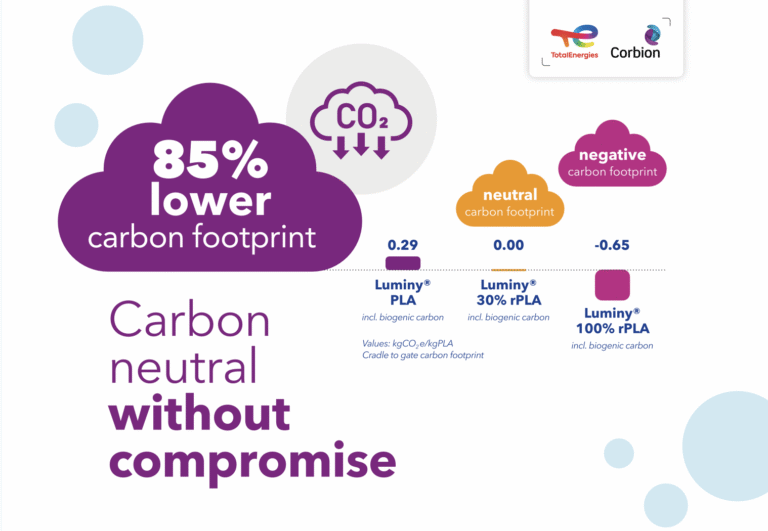
A key environmental advantage of PLA lies in its biogenic carbon cycle. The plants used as feedstock absorb CO₂ during growth, temporarily storing atmospheric carbon that is then incorporated into the material. Life cycle assessments conducted by TotalEnergies Corbion show that Luminy® PLA can reduce the carbon footprint by up to 85% compared with conventional plastics, with a cradle to gate footprint of around 0.29 kg CO₂ eq per kilogram when biogenic carbon is included. When recycled, Luminy® rPLA can achieve even lower impacts — around –0.65 kg CO₂ eq per kilogram — reinforcing its relevance as brands increasingly focus on reducing Scope 3 emissions.
The PPWR recognises that compostable packaging can deliver environmental benefits for specific applications, particularly where food contamination limits recycling efficiency. At the same time, PLA can be recycled both mechanically and chemically. At TotalEnergies Corbion, chemical recycling of PLA is already operating at commercial scale, enabling the production of high quality recycled PLA, including food contact compliant rPLA, and demonstrating that circular PLA systems are already a reality.
These developments are already visible in real world applications. From flexible and rigid packaging to foamed materials, nonwovens and durable goods, PLA is being used to design solutions that combine performance with circularity. Design innovations — such as label free bottles — further illustrate how materials and design choices together can improve recyclability and support cleaner material streams.
At Interpack 2026 Booth 10 B58, TotalEnergies Corbion invites visitors to explore how Luminy® PLA is expanding what’s possible in circular packaging — from flexible and rigid applications to foams, nonwovens and durable goods. The future of packaging will be built on materials that combine performance, circularity and low carbon impact. PLA is already helping make that future a reality — and the conversation is just getting started.